Steel for a decarbonized future
Protection of the environment and the climate, conservation of natural resources and prudent use of energy constitute key issues for Salzgitter AG. For us, protecting the climate and the environment goes beyond the observance of statutory regulations, as it plays a decisive role in shaping our corporate behavior – now and in the future. For that reason, we are playing a pioneering role in the decarbonization of the steel industry with our SALCOS® project that is without compare throughout Europe.
Our Contribution at Ilsenburg
As a Salzgitter AG company, we also contribute to achieving the Group-wide corporate goals. With the transformation of steel production toward low-emission processes, our own decarbonization ambitions have a much greater impact on the overall environmental balance. By 2045, we have set ourselves the goal of gradually reducing Scope 1 + 2 emissions by up to 90% (based on 2021 levels). Scope 1 emissions refer to the direct production of our heavy plate at the Ilsenburg plant, and Scope 2 emissions refer to indirect emissions from the generation of the electricity we purchase and consume.
The first targets have already been achieved: thanks to initial energy management measures, we are already saving around 30% of the previous CO2 emissions at the site.
Sustainable Manufacturing with Steel
Thanks to its high load-bearing capacity and delicate structure compared to other building materials, steel is not only resource-efficient, but also extremely durable and can be recycled almost indefinitely after its useful life. If it is also manufactured in an emission-reduced manner, it can significantly improve the ecological footprint of buildings, machines, plants, and much more.
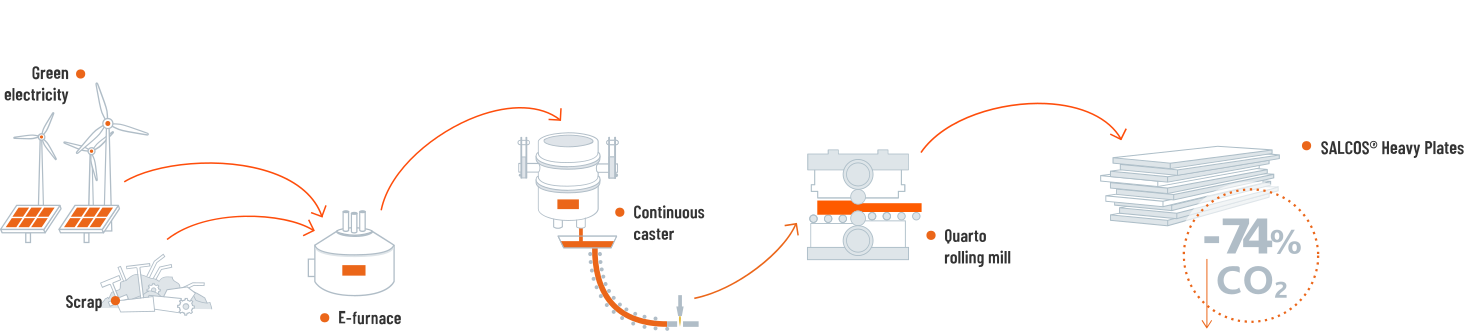
With low-emission heavy plates, we are already making a decisive contribution to the decarbonization of your projects. With steel from the scrap-based electric arc furnace route, we guarantee you heavy plate with up to 74% reduced CO₂ emissions. These have a global warming potential (GWP) of 591 kg CO₂ equivalent per ton, which is significantly lower than the emission values of conventionally produced products.


36 "Greener Tower" for Siemens Gamesa
Ilsenburger Grobblech GmbH is supplying around 25,000 tons of heavy plate to wind turbine manufacturer Siemens Gamesa for the construction of 36 low-emission wind towers. These wind towers are known as the “Siemens Gamesa Greener Tower” which is characterized by low CO2eq emissions of less than 700 kg per ton of steel. This is a significant step for the industry, as the production of wind towers alone accounts for more than two-thirds of all CO2eq emissions from wind turbines.

Low-emission onshore wind tower from Enercon
Wind turbine manufacturer ENERCON is building the first low-emission steel tower in Germany, making it one of the pioneers in the wind energy sector internationally. The tower was manufactured in collaboration with our long-standing customer, SMB Schönebecker Maschinenbau GmbH, and was installed in the Diepholzer Bruch wind farm project (Lower Saxony) at the beginning of 2025. For our customer Enercon, this represents another important step towards greater sustainability in the production processes of wind turbines.
Learn more
Sennebogen builds Green Material Handler
The pioneering project between SENNEBOGEN Maschinenfabrik GmbH and the Salzgitter Group impressively demonstrates how circular economy works in steel construction: In response to a special order from long-standing customer DEUMU, SENNEBOGEN has manufactured an material handler for the first time using CO2-reduced heavy plate from the group's own electric arc furnace route (including green electricity). Compared to conventional steel production in a blast furnace, the use of 100 percent scrap causes over 70 percent less CO2 emissions – and thus reduces the CO2 footprint of the end product immensely.
Learn more

Low Emission Steel Standard (LESS)
With the Low Emission Steel Standard (LESS), the German Steel Association, in cooperation with its member companies and the Federal Ministry for Economic Affairs and Climate Protection (BMWK), has created an industry-wide, internationally compatible labeling system for CO2-reduced steel that enables transparency and comparability. The classification system transparently categorizes steel manufacturing processes into six classes based on scrap content and CO2 emissions. With heavy plate made from the group's own scrap-based electric steel and green electricity, we achieve class B in the “Low Emission” classification.


Environmental Product Declaration (EPD)
The Environmental Product Declaration (EPD) provides detailed and standardized information about the environmental impact of building materials, construction products, or building components. It includes quantitative, objective, and verified data on the life cycle and forms an important basis for sustainability assessment.
Singapore Green Building Council (SGBC)
The Singapore Green Building Council (SGBC) is a non-profit, member-supported organization in Singapore that brings together stakeholders from the private and public sectors to promote environmentally friendly construction. SGBC is also an established member of the World Green Building Council, a network of nearly 70 national green building councils around the world.
As a member, Ilsenburger Grobblech joins more than 420 organizations from across the construction value chain and offers a wide range of certified CO2-reduced heavy plates for sustainable construction.


Leading the transformation with SALCOS®
Since 2015, we have been working with partners from industry and research on the path to virtually climate-neutral steel production. The core of the program is the switch from coal-based steel production to hydrogen-powered direct reduction plants and electricity from renewable sources. By the mid-2030s, we will be technically able to reduce our CO2 emissions by around 95 percent.
Our SALCOS® brand stands for physically CO2-reduced green steel products from the Salzgitter Group with a clear product promise and transparent certification. It is the strong result of our vision to transform the industry together with our customers and make a real contribution to decarbonisation. Physically CO2-reduced steel products can already be sourced from the Group's electric arc furnace route. With the start of steel production via the DRP-EAF route in the first half of 2027, green steel products from the transformation program of the same name will follow.
We already offer low-emission SALCOS® heavy plates for your projects – made possible by our physically CO2-reduced SALCOS® Structural Steel from the electric arc furnace route of our sister company Peiner Träger GmbH. Thanks to the use of 100% scrap recycling, SALCOS® Heavy Plates achieve a CO2 value of only 591 kg CO2e/t. Our EPD transparently shows you the environmental impact of SALCOS® Heavy Plate. In addition, the heavy plates from the Peiner route, made from scrap-based electric steel using green electricity, are classified in category B of the Low Emission Steel Standard (LESS). With the start of steel production via the DRP-EAF route in the first half of 2027, green steel products from the transformation program of the same name will follow.